Custom primer design for Cytos
Design RT and sequencing primers for custom RNA sequencing targets in Custom Designer.
When including guide RNA sequencing in a Cytos OPS or MPS run, the primers targeting specific guide RNAs used in the experiment must be designed and ordered prior to the run. For standard guide RNA applications, Custom Designer creates primers that accurately target guide RNA regions you identify. However, to target a custom region of interest (ROI) for advanced applications (e.g., viral transcript sequences, gene-fusion junctions) customers are responsible for generating and ordering their own primers.
Standard and custom primers
- Guide RNA sequencing (OPS, MPS, spacers): you supply a short flanking sequence from the gRNA to Custom Designer, which designs the compatible RT and sequencing primers for the experiment. For more information, see Guide RNA sequencing.
- Advanced non-guide applications (viral transcripts, gene fusions): you design your own primers and upload them to Custom Designer during run planning. For more information, see Advanced non-guide applications.
How Direct In Sample Sequencing works
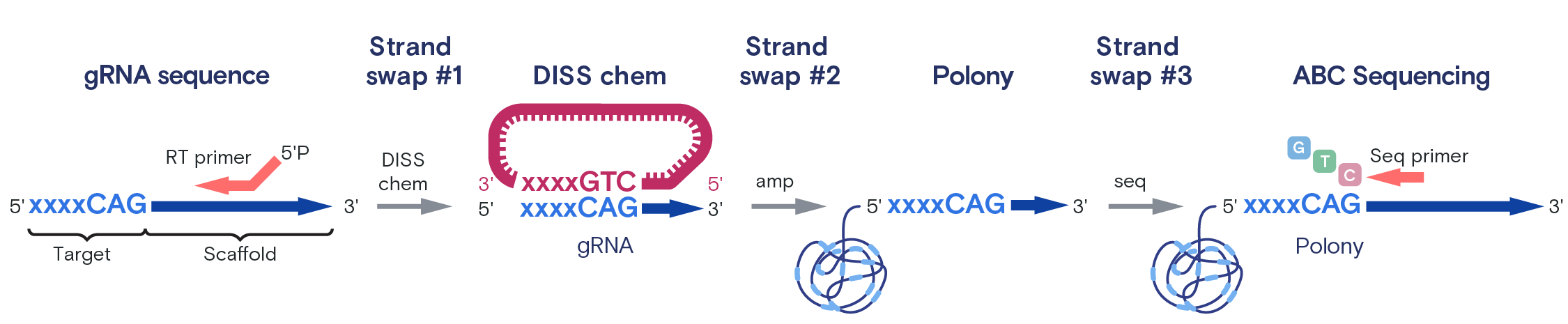
Direct In Sample Sequencing (DISS) chemistry profiles native RNA by reverse transcribing a region of interest (ROI) into cDNA, circularizing and amplifying cDNA by rolling-circle amplification (RCA) and then reading it with Avidite Base Chemistry™ (ABC™).
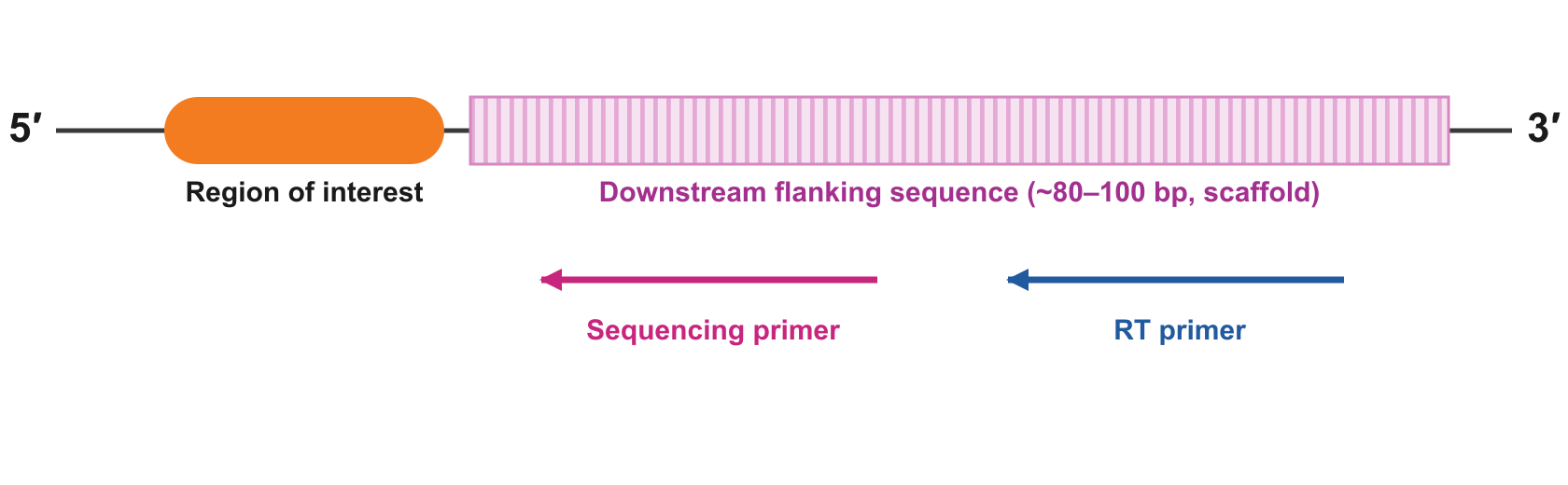
DISS uses a dual-primer design. A reverse transcription (RT) primer initiates reverse transcription of the ROI. The resulting cDNA is circularized and amplified by RCA into a polony, a clonal concatemer that a sequencing primer then reads by ABC sequencing. Requiring both an RT primer and a sequencing primer to bind increases specificity and reduces off-target reads.

All primer positions are described 5′ to 3′ on the same strand you submit, unless stated otherwise. Both primers sit in the downstream flanking sequence 3′ of the ROI: the RT primer is the outer site, and the sequencing primer is the inner site, immediately 3′ of the ROI and non-overlapping with the RT primer. The sequencing primer binds after circularization, and RCA generates the polonies that Avidite Base Chemistry reads during sequencing.
Guide RNA sequencing
Use this path for OPS, spacers, and guide sequencing experiments, where a perturbation is assigned to each cell. In the context of CRISPR, the target site is the sequence the guide spacer is designed to target, and the spacer is the variable, approximately 20 bp guide sequence that serves as the ROI in a guide run. The assay reads the gRNA spacer sequence to identify which knockout is present in a cell. It does not sequence the gRNA target itself. Custom Designer designs primers to the spacer flanking region to include the guide spacer in the final product.
How guide primers are designed
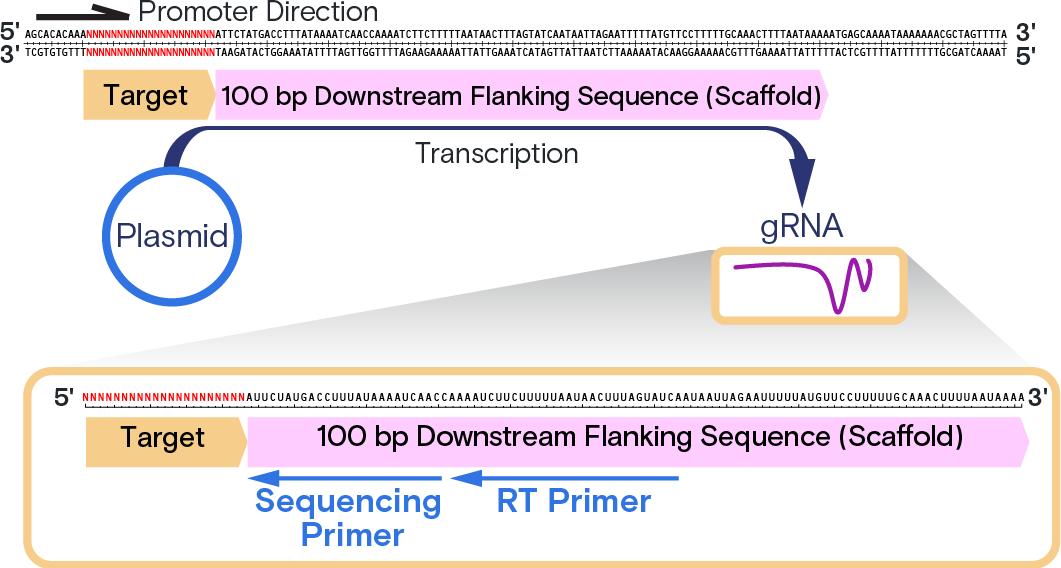
Custom Designer designs the RT and sequencing primers for you, anchored to each gRNA target site so the assay reads that site's ROI, using the spacer with its flanking region as context. For each target site, up to 5 per design, you provide the following:
You provide:
| Field | Description |
|---|---|
| Target site name | Matches the name used later in run planning (case-sensitive). |
| Cycle length | Equal to or greater than the spacer length, up to 50 cycles. |
| Downstream flanking sequence | 80–100 bp 3′ of the spacer, entered 5′ to 3′. |
| Primer oligos | Generated primers. Order RT primers HPLC purified with a 5′ phosphate. Sequencing primers can be desalted. |
Assignment settings:
| Field | Description |
|---|---|
| Perform target cell assignment | Select Yes for spacers; requires a target cell assignment manifest. |
TargetMask | Cycles where the spacer is present (for example, Y20N*); up to 50 bp, and must match the manifest. |
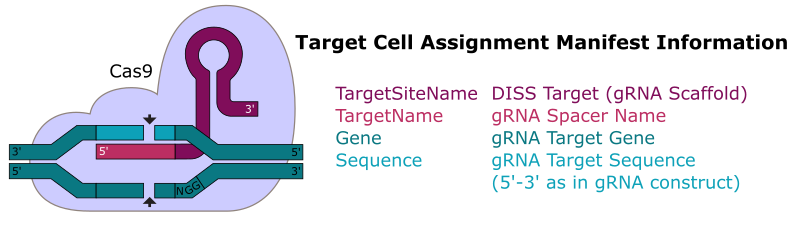
Each target cell assignment manifest column maps to a gRNA feature used in primer design:
TargetSiteName: the DISS target, which corresponds to the gRNA scaffold.TargetName: the gRNA spacer name.Gene: the gRNA target gene.Sequence: the gRNA target sequence, entered 5′ to 3′ as it appears in the gRNA construct.
Names must match the manifest exactly, including capitalization, so that each read is assigned to the correct perturbation. For more information on preparing this manifest, see Prepare a target cell assignment manifest.
Advanced non-guide applications
For ROIs beyond gRNAs, such as viral transcripts, gene-fusion junctions, splice sites, and exogenous sequences, you design the RT and sequencing primers yourself and upload them under the Advanced Non-Guide RNA Sequencing Applications setting in Custom Designer. Each ROI has its own flanking sequence, so each ROI needs its own dedicated RT primer and sequencing primer.
For non-guide RNA sequencing applications, you assume the risk of run failures and reduced run performance. Contact Element Technical Support to discuss your use case and optimize your primer designs.
Cover larger genes and fusions
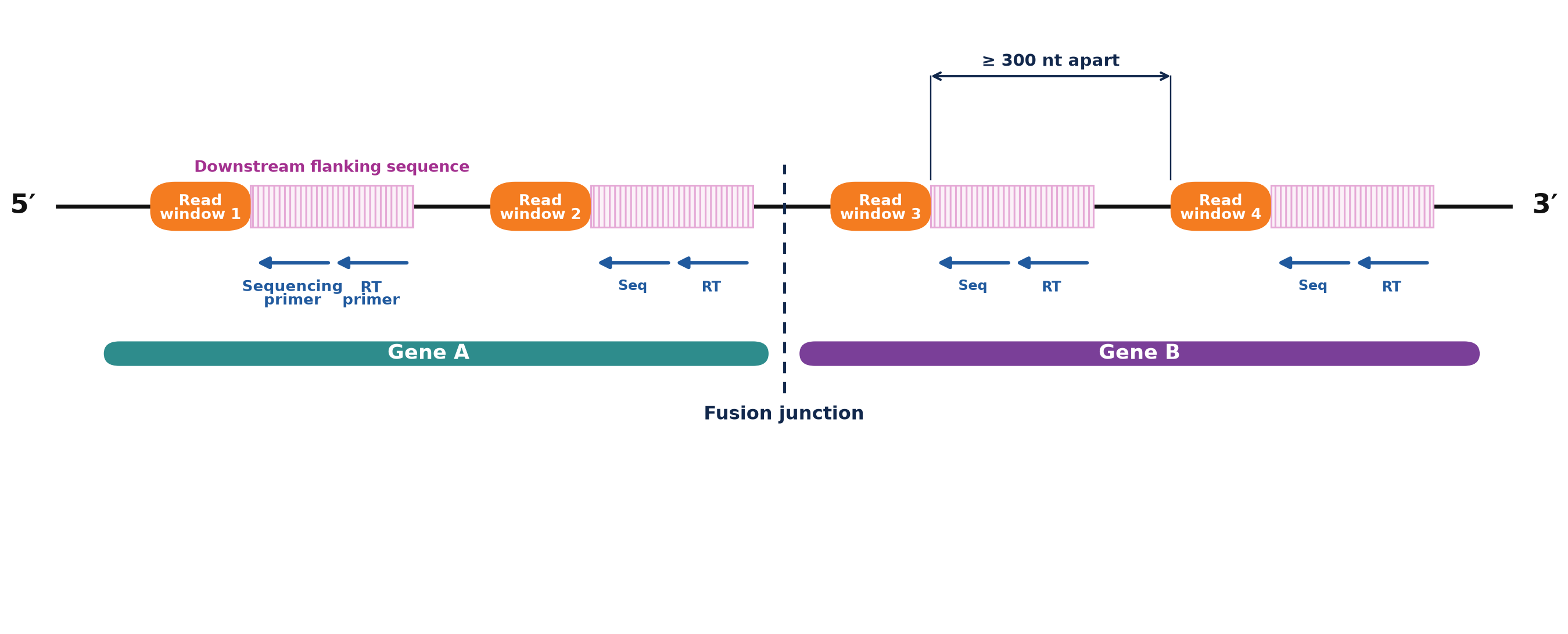
A full-length read can exceed the recommended size for efficient circularization. One primer design reliably covers roughly the first 50–90 nt of an ROI. To sequence larger genes and fusion transcripts, tile several primer pairs across the transcript, with each pair reading its own window. For example, bracket a fusion junction from both sides using a pair on each side of the junction. Space multiple primer pairs for the same transcript at least 300 nt apart. Guide RNA sequencing reads a short region (50 bp or fewer), so a single primer pair is sufficient there.
Primer design requirements (advanced non-guide applications)
| Category | Requirement |
|---|---|
| Before you design | |
| Additional guidance |
| Primer | Requirement |
|---|---|
| RT primer | CAGCCGCATCTTCTTTTGC to the 5′ end |
| Sequencing primer |
Contact Element Technical Support if a primer cannot reach a 1 µM final concentration, or if your design includes more than 50 targets.
Cytos RT/Seq Control Primers for mouse cells
Element Biosciences provides human control primers (GAPDH and ACTB) with the OPS and MPS kits, so no additional ordering is needed for human cell runs. For mouse cell runs, customers must order the mouse control primers listed below before planning the run — Custom Designer will return an error if no controls are provided. Selecting the no-controls option is possible but is not recommended, as controls are essential for troubleshooting and validating run performance.
Element does not provide Cytos Control Primers for mouse cell lines. These are required to be ordered for runs using mouse cells with the OPS or MPS kits. To order controls for mouse GAPDH and ACTB, use the following sequences.
RT primers:
| Gene | RT primer | RT primer sequence (5' to 3') |
|---|---|---|
| GAPDH | mGAPDH_RTP1 | /5Phos/CAGCCGCATCTTCTTTTGCGAGTCATACTGGAACATGTAGACCATGT |
| GAPDH | mGAPDH_RTP2 | /5Phos/CAGCCGCATCTTCTTTTGCCAAAGTTGTCATGGATGACCTTG |
| GAPDH | mGAPDH_RTP3 | /5Phos/CAGCCGCATCTTCTTTTGCCTGCTTCACCACCTTCTTGATGT |
| GAPDH | mGAPDH_RTP4 | /5Phos/CAGCCGCATCTTCTTTTGCTTCTTACTCCTTGGAGGCCATGTAG |
| ACTB | mACTB_RTP1 | /5Phos/CAGCCGCATCTTCTTTTGCACATGCCGGAGCCGTTGTCGA |
| ACTB | mACTB_RTP2 | /5Phos/CAGCCGCATCTTCTTTTGCTACGTACATGGCTGGGGTGTTGA |
| ACTB | mACTB_RTP3 | /5Phos/CAGCCGCATCTTCTTTTGCTCAGGCAGCTCATAGCTCTTCTCCAG |
| ACTB | mACTB_RTP4 | /5Phos/CAGCCGCATCTTCTTTTGCACGATGGAGGGGCCGGACTCATC |
Sequencing primers:
| Gene | Sequencing primer | Sequencing primer sequence (5' to 3') |
|---|---|---|
| GAPDH | mGAPDH_SeqP1 | TGTAGTTGAGGTCAATGAAGGGGTC |
| GAPDH | mGAPDH_SeqP2 | GCTAAGCAGTTGGTGGTGCAGGA |
| GAPDH | mGAPDH_SeqP3 | ATACTTGGCAGGTTTCTCCAGGCG |
| GAPDH | mGAPDH_SeqP4 | CATGTAGGCCATGAGGTCCACCAC |
| ACTB | mACTB_SeqP1 | CAGCGATATCGTCATCCATGGCG |
| ACTB | mACTB_SeqP2 | GTCTCAAACATGATCTGGGTCATCTTTTCA |
| ACTB | mACTB_SeqP3 | TTCTCCAGGGAGGAAGAGGATGC |
| ACTB | mACTB_SeqP4 | GTACTCCTGCTTGCTGATCCACAT |
Input and ordering guidance
For advanced non-guide applications, upload a CSV file with the target name and the RT and sequencing primer sequences under the Advanced Non-Guide RNA Sequencing Applications setting. The following ordering and yield guidance applies to RT and sequencing primers for any guide RNA sequencing application, guide or advanced. Confirm that the adapter sequence, 5′ phosphate, and 3′ hydroxyl are present on every RT primer before you order.
| Category | Requirement |
|---|---|
| Ordering | |
| Minimum yield |
Summary
For guide RNA sequencing and OPS, Custom Designer designs the primers for you from a short downstream flanking sequence. For advanced non-guide applications, you design your own primers around the ROI or tile multiple pairs to cover larger regions. Log in to ElemBio Cloud to open Custom Designer. For advanced applications, contact Element Technical Support or your Element representative.